Pencil Power: How Drawing Can Support Focus and Executive Skills
_ZNuWDg.webp)
Families often explore practical activities that may support attention and coordination alongside appropriate ADHD care. Behavioral therapy is clinical care, while ADHD coaching focuses on practicing routines and executive skills rather than treating ADHD.
Two activities families sometimes explore for coordination and focus are balance training and drawing. Here is what those exercises involve and where the evidence has limits.
Why Families Explore Balance Exercises for ADHD Support
Some families try simple balance exercises as movement practice. Activities such as standing on one leg or learning to juggle can challenge coordination, but they should not be presented as proven ADHD treatment.
Balance exercises work because the area in the brain responsible for coordination and precise movement - the cerebellum - is intricately connected to the region of the brain that controls executive functioning - the prefrontal cortex. Kids with ADHD are known to have executive functioning difficulties - time management, organization, impulse control, and focus - to name a few.
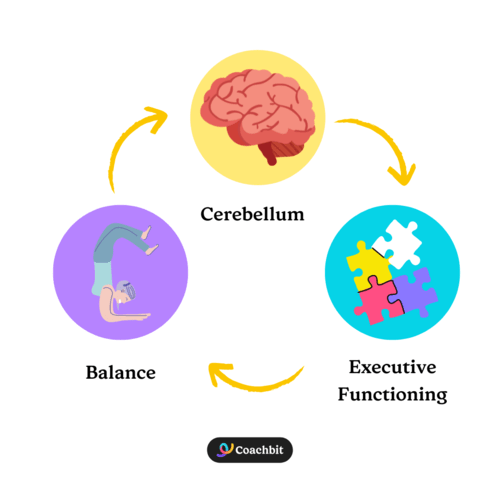
Balance activities engage coordination and require attention. That makes them useful practice activities, but improving balance does not by itself establish an improvement in executive functioning.
Drawing Can Improve Executive Functioning Skills in Teens with ADHD
Simple activities at home can give kids a low-pressure way to practice coordination and sustained attention. Novel, engaging exercises may be easier to repeat, but they are not a substitute for evidence-based ADHD care.
Drawing is another accessible activity kids can do at home. It involves fine motor skills, precise movement, timing and coordination. Regular practice can build drawing and fine-motor skills while also asking kids to plan, monitor and complete a task.
So how can you get your kids to draw in a way that stimulates their cerebellum? We've put together a few tips and exercises to help.
Try These 5 Drawing Exercises with Your Kids
For younger kids, coloring-in books are a great way to practice drawing in the lines and holding a pencil. Older kids may need to be challenged more.
These exercises mostly require a piece of paper, a pencil, and scissors to cut some shapes. Try these exercises for 10 to 15 minutes at a time and notice which ones your child finds engaging.
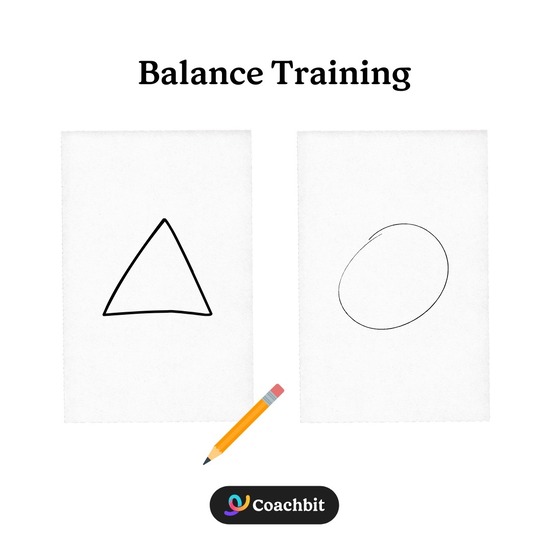
#1 Place a blank sheet of paper on your right and another on your left. Hold a pencil in each hand. At the same time, draw a straight line vertically on the sheet on the right and a round shape (circle) on the sheet on the left. Repeat this sequence three times, alternating the figures on each sheet.
#2 Place a sheet of paper on your right and left side. On the right, draw a triangle, and on the left, draw a square (at the same time). Then switch: draw the square on the first sheet and the triangle on the second sheet.
#3 On one sheet, draw a circle; on the other, draw a triangle. Then swap the figures and repeat the processs.
#4 Draw two circular shapes (circles) on one sheet while simultaneously drawing one four-sided shape (square) on the other sheet. Then switch the figures between the sheets.
#5 Draw a circular shape with one hand and a triangle with the other hand while using one leg to trace a square shape on the floor. Then switch hands for drawing and switch legs for tracing the square shape.
Final Thoughts
Drawing exercises are not a treatment for ADHD. They can be a fun way to practice motor coordination, attention and planning, and they may fit alongside care recommended by a qualified health professional. If your child enjoys them, bring out some pens and pencils and treat the activity as practice, not therapy.
Disclaimer: This is not intended to be a substitute for professional medical advice and should not be relied on as health or personal advice. Always seek the guidance of your doctor or other qualified health professionals with any questions you may have regarding your health or a medical condition
Sources:
Feng Lei, Ren Yuanchun, Cheng Jia, Wang Yufeng, "Balance Training as an Adjunct to Methylphenidate: A Randomized Controlled Pilot Study of Behavioral Improvement Among Children With ADHD in China," Frontiers in Psychiatry, Vol 11, 2021.
Budde H, Voelcker-Rehage C, Pietrabyk-Kendziorra S, Ribeiro P, Tidow G. "Acute coordinative exercise improves attentional performance in adolescents."_ Neuroscience Letters_, 2008 Aug 22;441(2):219-23
Edward Hallowell and John Ratey, ADHD 2.0: New Science and Essential Strategies for Thriving with Distraction--from Childhood through Adulthood.
Edward Hallowell and John Ratey, Delivered from Distraction: Getting the Most out of Life with Attention Deficit Disorder
How many core habits and skills is your child missing?
Take our short quiz and find out.
Take our quiz
_f1nSk.webp)
_Z1T8A9c.webp)
_Z28B9Xm.webp)