
7:00 AM Morning routine
Wake up
Make bed
Set focus
🔥 12-day streak
Three for three before school. Strong start 💪
For students aged 11–21
The essay gets written at 11pm the night before. The studying happens in the car on the way in. You've tried consequences, rewards and speeches. A coach on their phone each weekday tries something different: practice.

Why teens procrastinate
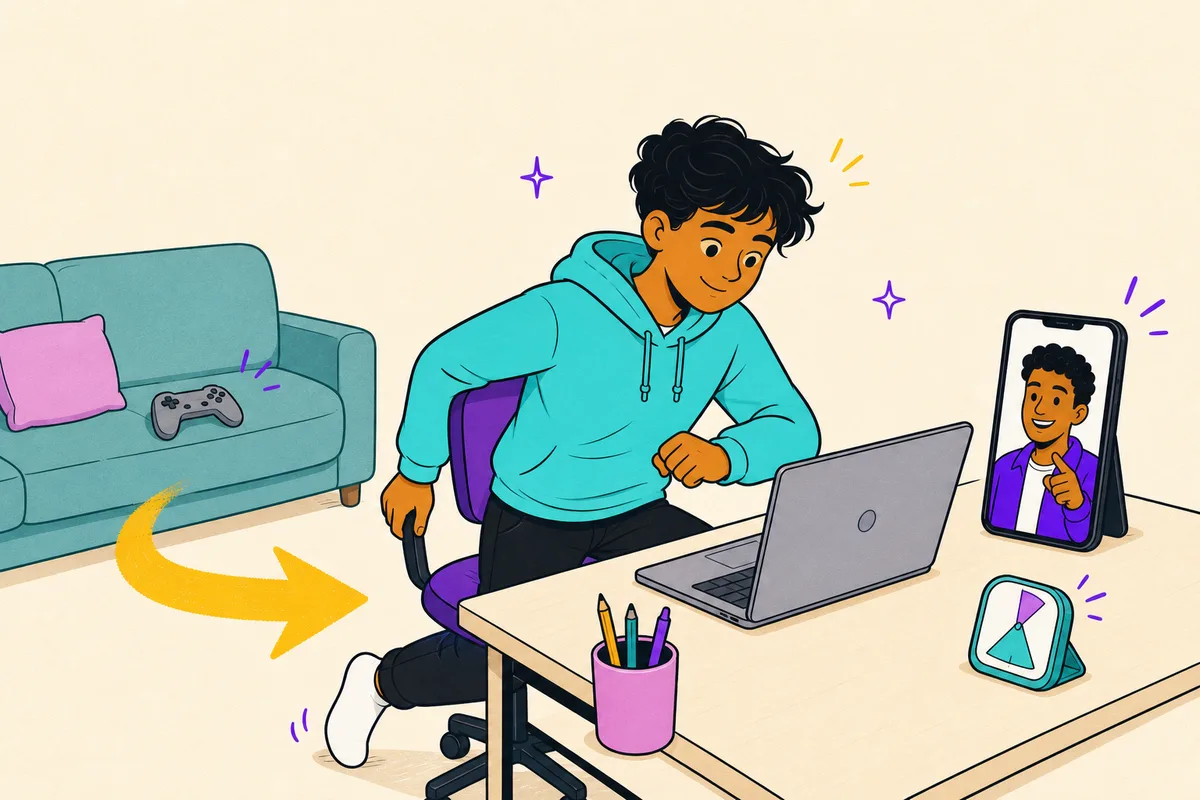
Teens procrastinate mostly because starting feels bad: the task is vague, big, or boring, and the teenage brain discounts future consequences steeply. It's a task-initiation skill gap, not a character flaw. The fix that works is shrinking the start: one small, concrete first step, practiced daily with support until starting becomes automatic.
01 · The pattern, up close
Four scenes from the night-before household:
The 11pm author
A week of runway, all of it spent orbiting the desk.
“I work better under pressure”
The story that explains the panic, not a strategy.
Starts everything but homework
No trouble starting a game, a snack, a shower debate.
The avalanche
Small delays stacking into a hole too deep to want to look at.
02 · Why pressure hasn't worked
Consequences raise the stakes, and higher stakes make starting feel worse, which is the exact problem. What builds the starting skill is the same thing that builds any skill: small, repeated, supported practice. A Coachbit coach meets the student by live video on their phone every weekday to shrink today's start to something winnable and see it land. App tools build the surrounding system throughout the day: breaking work down, planning backwards from deadlines and creating a start ritual that fires without willpower.
Executive dysfunction, explained → · Motivation coaching → · Homework battles →
03 · Coaching, therapy, or both?
Coaching is not therapy and Coachbit doesn't diagnose or provide medical care of any kind. Persistent avoidance sometimes travels with anxiety or ADHD. If a diagnosis question is on the table, a licensed clinician is the right first step. Many families run both: the clinician handles care, the coach handles the daily skills-and-systems layer.
The daily model
Shrink the start. Land it. Repeat until it's automatic.
Three for three before school. Strong start 💪
Outline first, perfection later. You've got this.
Tomorrow's already easier. See you at 7.
You see the change, without having to police it.
60+ habits to pick from: handpicked for what your teen needs most.
04 · What changes
10,000 +
families coached
4.8 /5
on Trustpilot
340 +
Trustpilot reviews
“My son was barely passing last year and now has As & Bs. This program is making a huge difference because it is every day for short periods of time.”
“No more missing assignments, all grades in the 90s, and getting to school is super easy with the new morning routine.”
“My son has transformed from a child who was scattered and overwhelmed to the first one ready to get out the door in the morning.”
“Out the blue, my daughter told me, I love coach Latia and it is working, I feel more organized!”
“[…] She motivated my daughter to stay more organized and practice strategies to stay on top of her work. […]”
“I wake up and find the kids up before me, clean bedrooms. […] they have a sense of ownership rather than because they were asked to.”
“Coachbit has been a game-changer for our son with ADHD. […] He's more organized, motivated, and confident. […]”
“[…] his grades improved from B's and C's to almost all A's! […] he has grown in to a calm, fairly confident college student with a plan to tackle life's daily challenges. […]”
FAQ
Shrink the start, don't raise the stakes. One small, concrete first step (open the doc and write the title) practiced daily with support beats any consequence system. External accountability from a non-parent adult makes the practice stick; that's the coach's role.
Usually a mix of task-initiation skill gaps and a brain that steeply discounts future consequences, both normal in adolescence, both improvable with practice. It's rarely laziness: watch how fast they start things that feel good.
It can travel with either, and it can stand alone as an executive-skill gap. Diagnosis questions belong with a licensed clinician. The starting skill responds to the same daily practice in every case.
Coaching works on procrastination precisely because the problem is behavioral: the fix is repetitions of successful starting, and a coach on their phone each weekday manufactures those repetitions. One-off advice doesn't; daily practice does.
A real coach meets the student by live video on their phone every weekday to set and land one small start. App tools support planning, breaking down work and deadline maps throughout the day. Ages 11–21.
Take the 2-minute quiz and we'll show plans for the student's situation. Many qualifying families use HSA/FSA funds, subject to their plan administrator. Coaching is covered by a 30-day money-back guarantee.
More from Coachbit
Take the 2-minute quiz, or book a call with our team. HSA/FSA may be available for qualifying accounts; 30-day money-back guarantee.
How many core habits and
skills is your child missing?
Take our short quiz and find out.
Take the 2-minute quiz