For the new year and the new semester
This year could actually be different. Here's the mechanism.
Resolutions don't fail from lack of sincerity. They fail from lack of structure. Live video coaching on the student's phone every weekday and app tools throughout the day help January's intentions survive February.


Why resolutions fail
Most resolutions fail within weeks for three predictable reasons: they're too big (identity leaps instead of small steps), they have no daily feedback (nothing notices a missed day until it's a missed month), and they rely on the motivation that made them, which fades by design. Fixing those three is a system, and systems can be built.
01 · The January advantage (and its trap)
The new semester is a real reset
Four things to know about the window you're standing in:
The fresh-start effect is real
New year, new semester: behavior change genuinely comes easier at temporal landmarks.
The gym-in-January trap
Starting five changes at once guarantees zero survive; the fresh start funds ONE habit.
A clean semester
Last term's grades are archived; the gradebook literally resets. Momentum has nowhere to hide.
February is the test
Whatever structure exists on Feb 15 is what the year will actually run on.
02 · The reset that holds
One habit, daily support, four weeks, then the next one
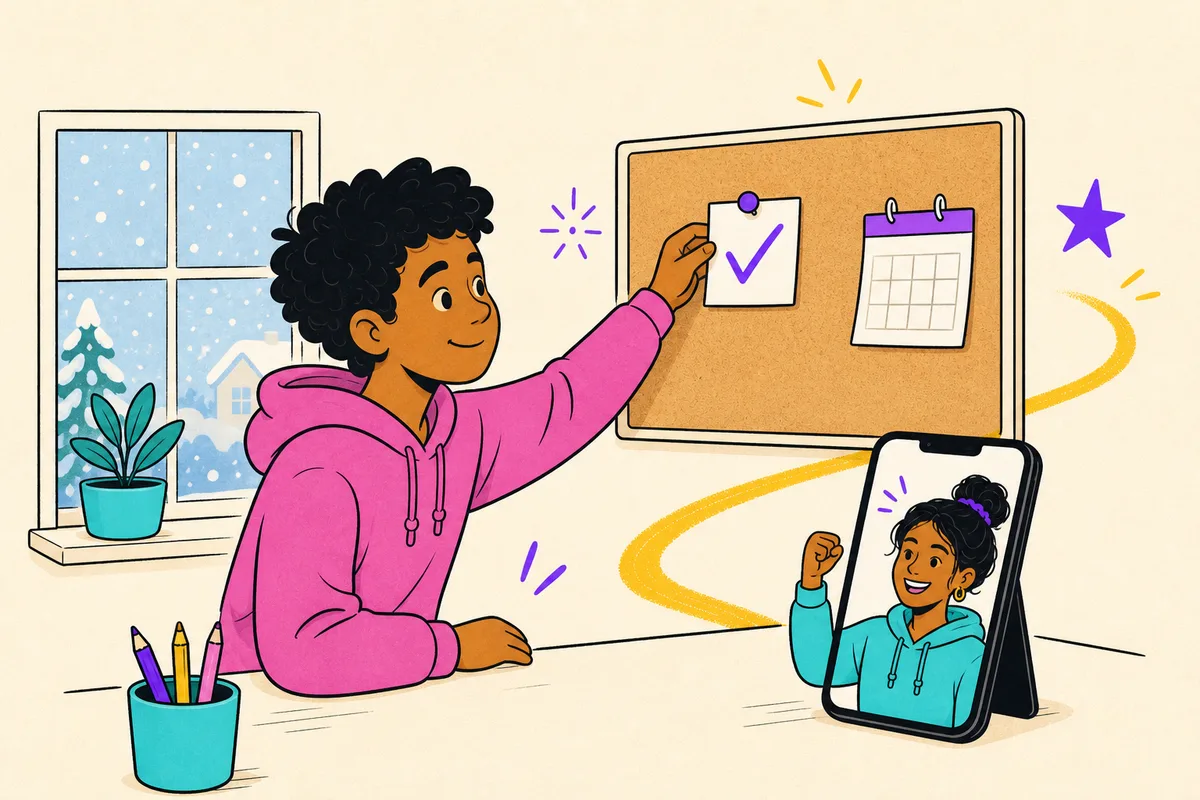
The version that works is unglamorous: pick ONE keystone habit (a fixed homework start, a real bedtime, planner capture), shrink it until it's winnable on a bad day, and put daily accountability on it until it runs itself. Then stack the next. That's precisely the Coachbit model: a real coach meets the student by live video on their phone every weekday to land one small step, while app tools keep the plan visible throughout the day. New year's resolve, given an engine.
Goal setting that sticks → · Routines that survive Wednesday → · Grades slipping instead? →
03 · Coaching, therapy, or both?
When a reset is not enough
Coaching is not therapy and Coachbit doesn't diagnose or provide medical care of any kind. If the new-year worry is about mood, anxiety or anything heavier than habits and grades, a licensed clinician is the right first step. Coaching is the daily skills-and-systems layer alongside.
04 · What changes
February, passed
- Week 1: one habit picked, shrunk to winnable, checked daily.
- Week 3–4: the streak survives its first bad day, because someone noticed and right-sized it.
- Feb 15: the structure is still standing, which means the year runs on it.
10,000 +
families coached
4.8 /5
on Trustpilot
340 +
Trustpilot reviews
“My son was barely passing last year and now has As & Bs. This program is making a huge difference because it is every day for short periods of time.”
“No more missing assignments, all grades in the 90s, and getting to school is super easy with the new morning routine.”
“My son has transformed from a child who was scattered and overwhelmed to the first one ready to get out the door in the morning.”
“Out the blue, my daughter told me, I love coach Latia and it is working, I feel more organized!”
“[…] She motivated my daughter to stay more organized and practice strategies to stay on top of her work. […]”
“I wake up and find the kids up before me, clean bedrooms. […] they have a sense of ownership rather than because they were asked to.”
“Coachbit has been a game-changer for our son with ADHD. […] He's more organized, motivated, and confident. […]”
“[…] his grades improved from B's and C's to almost all A's! […] he has grown in to a calm, fairly confident college student with a plan to tackle life's daily challenges. […]”
FAQ
Questions parents ask
What are good new year resolutions for teens?
The keystone ones: a consistent sleep schedule, a fixed daily homework start, and capturing every assignment in one planner. Each is small, daily and measurable, and each quietly carries a dozen other improvements with it.
Why do teenagers' resolutions fail so fast?
Same reasons as adults', amplified: goals too big, no daily feedback, and motivation that peaks the day the resolution is made. Teens add a fourth: the resolution was often the parent's idea. Ownership plus daily structure fixes all four.
Is January a good time to start coaching?
It's statistically our strongest month for families committing to change: the fresh-start effect plus a clean semester's gradebook. The habits built in January run the rest of the year.
How do I help my teen keep a resolution without nagging?
Outsource the coaching: a non-parent adult reviews the plan in live video sessions each weekday, while app tools keep the daily streak visible without the relationship cost.
How does Coachbit work?
A real coach meets the student by live video on their phone every weekday to land one small commitment. App tools support goal setting and systems throughout the day. Parents get weekly visibility. Ages 11–21.
How much does it cost?
Take the 2-minute quiz and we'll show plans for the student's situation. Many qualifying families use HSA/FSA funds, subject to their plan administrator. Coaching is covered by a 30-day money-back guarantee.
More from Coachbit
Resolutions are free. Systems are what survive February.
Take the 2-minute quiz, or book a call with our team. HSA/FSA may be available for qualifying accounts; 30-day money-back guarantee.